Will the switch to Apple TV mean a decline in Formula 1 viewership? ESPN is a reasonably convenient option for American fans, while only roughly 25% of American streamers use Apple Tv.
Will this be the bottleneck to F1 viewership in the US?
It would be great if Apple allowed viewers to watch races without requiring a subscription. With an Apple TV subscription, however, viewers would enjoy a more enhanced experience, including access to different camera angles, radio monitoring, and behind-the-scenes content. While we need to wait and see how the broadcast will be delivered, this approach could help Apple attract new users.
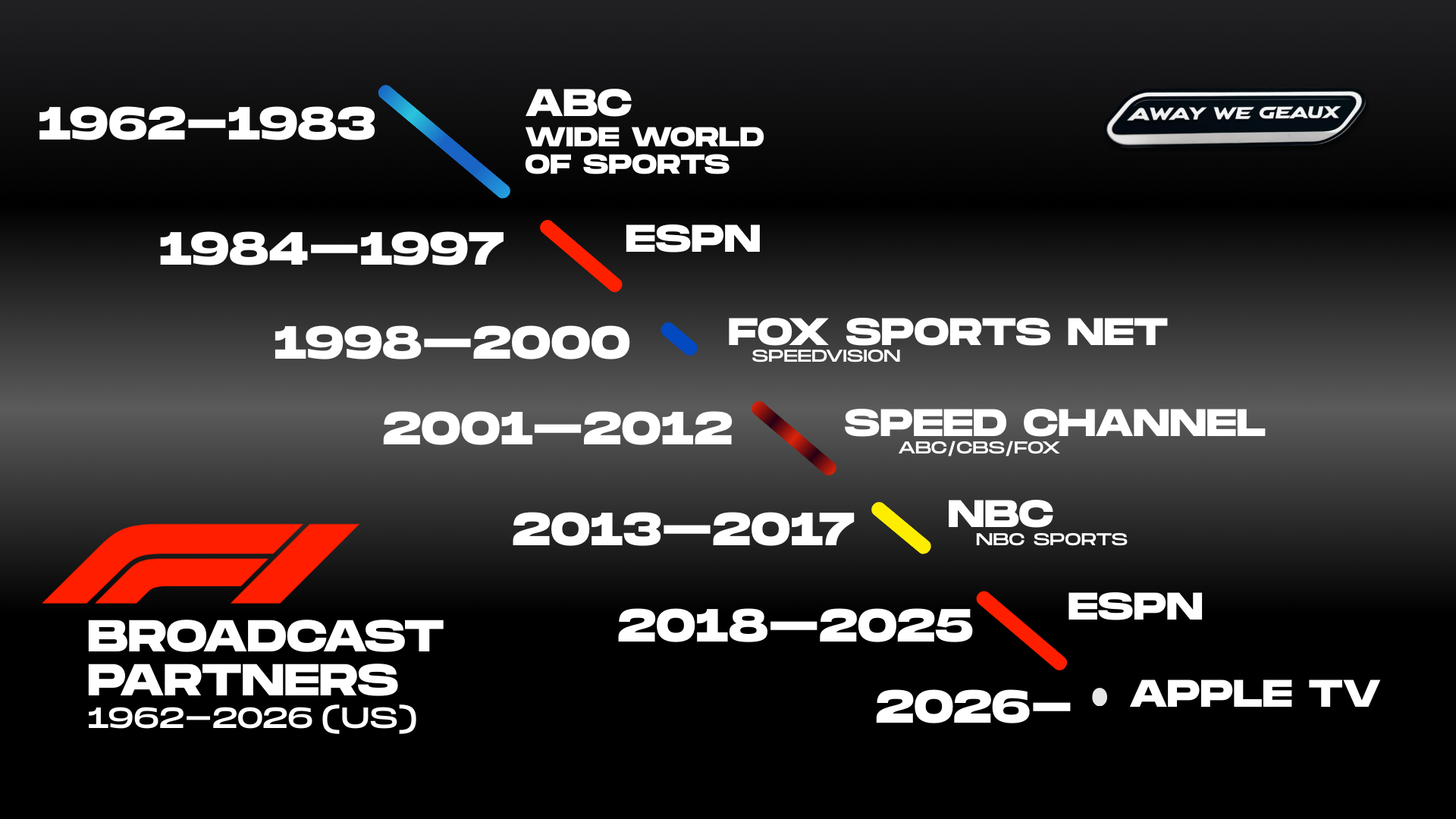
Formula 1's broadcast history in the United States has been a complex journey, characterized by phases of varying availability, experimentation, and, finally, a strategic approach to growth.
The Early Years (1960s–1980s)
F1 first appeared on American television in the early 1960s, mainly through ABC's "Wide World of Sports". These broadcasts were often delayed, which positioned Formula 1 as something exotic rather than essential. On June 10, 1962, the Monaco Grand Prix was broadcast to American viewers on a tape delay. Bruce McLaren won the race, and American driver Phil Hill finished 2nd. Wide World of Sports was the first to broadcast major sporting events in the US, including Wimbledon, the Indianapolis 500, and the Daytona 500. In 1967, the first color broadcast of the Monaco GP was delivered to American fans. This broadcast marked the beginning of America's love for F1. The sport was present in American sports culture — noticeable but never fully embraced.
ESPN's First Era (1984–1997)
ESPN provided Formula 1 with its first sustained presence in the US. Regular race broadcasts helped build a small but loyal audience. It was the 1984 Brazilian Grand Prix, held in Rio de Janeiro on March 25, marking the start of the F1 season and ESPN's initial 10-race deal for F1 coverage in the US. The broadcast was initially named "ESPN Auto Racing", and was later changed in the '86 season to "ESPN SpeedWorld". Still, F1 remained a niche sport. It had consistency, but lacked cultural reach.
The Speed Channel Years (1998–2012)
With the beginning of Speedvision (later known as Speed Channel), Formula 1 found its most devoted audience to date. Coverage was extensive, knowledgeable, and unapologetically focused on motorsport — but it remained behind cable paywalls. These years were defined by commitment rather than growth; if you watched F1, it was because you genuinely wanted to.
NBC Sports (2013–2017)
NBC reintroduced Formula 1 into a more mainstream sports environment, with races aired on both NBCSN and NBC. Production quality improved, and accessibility increased, but viewership plateaued. While F1 was present, it remained peripheral in a crowded American sports landscape.
ESPN Returns: Growth Finally Arrives (2018–2025)
F1's return to ESPN marked a significant turning point for the sport. The move to commercial-free broadcasts using Sky Sports' world feed, along with the cultural impact of "Drive to Survive," attracted a younger, more engaged audience. As a result, average viewership in the US more than doubled, exceeding one million viewers per race and reaching record highs by the mid-2020s.
Apple TV+ (2026– )
The shift to Apple TV represents the most significant decision yet for F1. For the first time, the series is choosing a platform designed around intentional viewing rather than passive discovery. This move prioritizes control, depth, and a premium experience over mass reach — betting that the future of fandom will be smaller, more engaged, and more global. The Apple TV era signifies a philosophical shift rather than just a change in broadcasting. Apple does not operate like a traditional sports network; it does not rely on channel surfing, highlight shows, or traditional viewing. Instead, it focuses on depth: improved production, enhanced technology integration, and attracting an audience willing to seek out the sport actively. In the short term, this decision risks limiting casual discovery; in the long term, it aligns with what Formula 1 has always been in America — a committed fanbase. Apple aims not to make F1 louder but to make it more compelling and integrated into an active fanbase.
Facts about US F1 Broadcasts
- F1 was on US television before the Super Bowl even existed. The Monaco Grand Prix aired on Wide World of Sports in 1962, four years before the first Super Bowl.
- For decades, most US F1 races were broadcast on tape delay. American fans often watched races hours — sometimes days — after they had occurred.